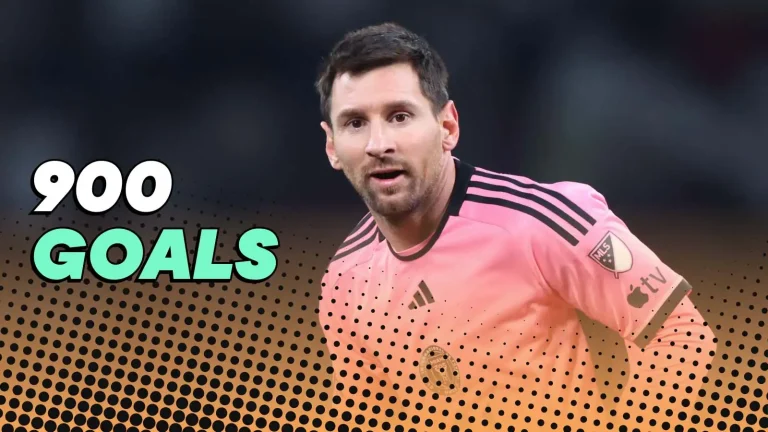
Lionel Messi 900th career goal record. The Argentine icon became just the second men’s player in history to reach 900 career goals, doing so in nearly 100 fewer matches than his legendary rival. But the historic night ended in heartbreak for Inter Miami.
Beyond the Milestone: The Numbers, the Rivalry, and the Bittersweet Night of Messi’s 900th Goal
The script could not have been written more perfectly—until it wasn’t.
For 83 minutes on Wednesday night at Chase Stadium, Lionel Messi’s 900th career goal stood as the decisive strike that would send Inter Miami into the Concacaf Champions Cup quarterfinals. The Argentine maestro had done what he has done for over two decades: deliver in the moment that mattered.
Then Cristian Espinoza happened.
The Nashville SC forward’s 74th-minute equalizer flipped the script entirely. With the first leg having ended scoreless in Tennessee, the 1-1 aggregate scoreline meant Nashville advanced on away goals, sending Inter Miami crashing out of the competition .
For Messi, it was a night of stark contrasts—individual glory wrapped in collective disappointment.
“It’s… you know, 900 goals is… Congratulations to him. He’s the best,” Nashville head coach B.J. Callaghan said afterward, offering his respects even as his team celebrated advancement .
Here is the full story of Messi’s historic milestone, the numbers that define it, and why this goal will be remembered for more than just the scoreline.
The Goal: A Signature Finish
It took Messi just seven minutes to etch his name into the record books yet again .
The sequence began with Sergio Reguilón, the Spanish left-back on loan from Tottenham Hotspur, delivering a perfectly weighted pass into the center of the penalty area. Messi, reading the play with the preternatural awareness that has defined his career, collected the ball with his left foot, took a single touch to create separation, and fired a low, precise strike past Nashville goalkeeper Brian Schwake into the far corner .
It was vintage Messi—the kind of finish fans have witnessed nearly a thousand times. Yet this one carried extra weight.
The goal marked his 81st for Inter Miami since joining Major League Soccer in 2023 . More significantly, it pushed his career total to 900, making him only the second male player in football history to reach that rarefied air .
The 900 Club: How Messi’s Goals Break Down
Messi’s journey to 900 goals spans 21 years, three clubs, and his national team. The breakdown tells the story of a career defined by sustained excellence :
| Team | Goals | Appearances | Key Period |
|---|---|---|---|
| Barcelona | 672 | 778 | 2004–2021 |
| Argentina | 115 | 196 | 2005–present |
| Inter Miami | 81 | 96 | 2023–present |
| Paris Saint-Germain | 32 | 75 | 2021–2023 |
| Total | 900 | 1,142 | 2005–2026 |
The Barcelona numbers remain staggering. Over 17 seasons with the Catalan giants, Messi averaged 0.86 goals per game, helping the club win 35 trophies including four Champions Leagues and 10 La Liga titles .
His international haul of 115 goals makes him the highest-scoring South American men’s player in history, with two of those goals coming in the 2022 World Cup final victory over France—arguably the crowning achievement of his career .
At Inter Miami, Messi has maintained remarkable efficiency with 81 goals in 96 appearances, helping the club win the 2023 Leagues Cup and the 2025 MLS Cup .
The Ronaldo Comparison: Efficiency vs. Volume
No discussion of Messi’s goalscoring achievements occurs without the shadow—or perhaps the sunlight—of Cristiano Ronaldo.
The Portuguese superstar was the first to reach 900 goals, achieving the milestone in September 2024 during Portugal’s Nations League match against Croatia . Ronaldo accomplished the feat at age 39 years and 7 months, in his 1,236th senior appearance .
Messi’s path to 900 tells a different story—one of greater efficiency. The Argentine reached the milestone at age 38 years and 9 months, in his 1,142nd match . That means Messi accomplished in nearly 100 fewer games what took Ronaldo almost 100 additional matches to achieve.
The comparison extends to their current totals. Ronaldo, now 41 and playing for Saudi club Al-Nassr, has pushed his career tally to 965 goals and has openly stated his ambition to reach 1,000 before retiring . Messi, with his Inter Miami contract extended through 2028 and a sixth World Cup on the horizon, will have opportunities to narrow that gap .
| Player | Goals | Matches | Goals per Match | Age at 900th |
|---|---|---|---|---|
| Cristiano Ronaldo | 965 | 1,236+ | 0.78 | 39 years, 7 months |
| Lionel Messi | 900 | 1,142 | 0.79 | 38 years, 9 months |
How Messi Scores: A Statistical Portrait
Beyond the raw totals, the numbers reveal fascinating patterns in how Messi finds the back of the net :
-
Left foot dominance: 755 of his 900 goals (84%) have come with his left foot—understandable for a player widely considered the finest left-footed finisher in history.
-
Right foot contributions: 111 goals with his right foot, demonstrating ambidexterity often overlooked in discussions of his game.
-
Headers: 30 goals with his head, a testament to his positioning and timing despite not being an aerial powerhouse.
-
Other: 4 goals classified as “other”—likely including chest, thigh, or accidental contacts.
Location matters as well:
-
Inside the box: 724 goals (80%)
-
Outside the box: 176 goals, highlighting his threat from distance
-
Penalties: 112 successful spot-kicks
-
Free kicks: 70 direct free-kick goals, placing him among the greatest dead-ball specialists in history
Messi’s favorite opponents? Sevilla has conceded 25 goals to him, followed by Athletic Club (24), Atlético Madrid (23), and Valencia (18). His 17 goals against Real Madrid rank among the most in El Clásico history .
The Bittersweet Ending: Inter Miami’s Continental Heartbreak
For all the individual glory, the night belonged to Nashville.
After Messi’s seventh-minute opener, Inter Miami controlled much of the match but failed to convert dominance into a decisive second goal. Nashville, compact and disciplined, waited for their opportunity .
It arrived in the 74th minute. A chaotic scramble in the Miami penalty area saw a clearance fall to Cristian Espinoza, who hammered a volley past the helpless goalkeeper. The goal made it 1-1 on the night and, crucially, 1-1 on aggregate .
With the away goals rule in effect, the equation shifted instantly. Inter Miami now needed an outright win to advance. Javier Mascherano sent on Luis Suárez and David Ayala in search of a winner, but Nashville’s defense held firm .
The final whistle confirmed the unthinkable: Inter Miami, with Messi at his historic best, was eliminated from the Champions Cup in the Round of 16.
“I haven’t contributed much to him scoring goals, neither with assists, nor now as a coach,” Mascherano said afterward, deflecting attention from the team’s exit to celebrate his former teammate’s achievement. “I’ve been lucky enough to see most, or many, of the goals he’s scored, much closer than you all, and that’s a privilege. The number we’re talking about [900] is insane, and that’s why Leo is one of a kind” .
What Comes Next: The Road to 1,000?
With 900 goals secured, attention naturally turns to whether Messi can join Ronaldo in chasing the 1,000-goal mark.
The math is daunting but not impossible. Messi’s current pace with Inter Miami (roughly 27 goals per season across all competitions) would require approximately four more seasons to add 100 goals. His contract extension through 2028 suggests he intends to play at least that long .
Then there is the World Cup. Messi is strongly expected to play in his sixth tournament later this year, when Argentina defends its title in the 48-team competition being staged across the United States, Canada, and Mexico . A deep run would offer multiple opportunities to add to his international tally.
For now, however, Messi and Inter Miami must quickly pivot. The team returns to Major League Soccer action on Sunday against New York City FC, with no time to dwell on continental disappointment .
The Verdict: A Night for the History Books
Lionel Messi’s 900th goal will be remembered as a quintessential Messi moment: technically perfect, historically significant, and ultimately overshadowed by team disappointment.
It is fitting, in a way. Throughout his career, Messi has measured success by team trophies rather than individual accolades. The eight Ballon d’Or awards are nice. The 900 goals are remarkable. But the World Cup, the Champions Leagues, the league titles—those are what matter.
Wednesday night at Chase Stadium offered a reminder that even the greatest individual achievements cannot guarantee team success. Football remains a collective endeavor, and Nashville SC’s disciplined performance proved that no single player, not even Lionel Messi, can win alone.
But for 67 minutes, Messi’s 900th goal stood as the difference-maker. And for the rest of football history, it will stand as proof of his enduring greatness.
What do you think—can Messi catch Ronaldo to 1,000 goals? Drop your thoughts in the comments below.