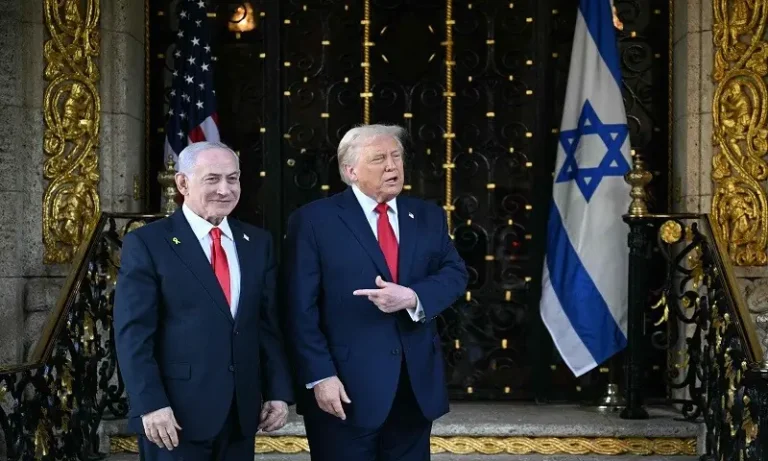
Israeli Prime Minister Benjamin Netanyahu arrived Monday at US President Donald Trump’s Mar-a-Lago residence for crucial talks on Gaza and Iran.
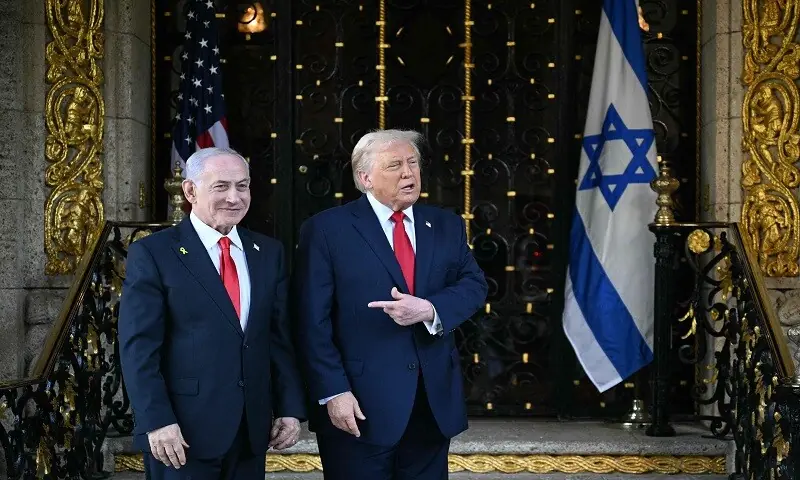
The US president will press the Israeli leader to move to the next stage of his fragile Gaza truce plan.
Netanyahu is also expected to try to shift the focus to Iran, amid reports that he will request more US strikes against the Islamic Republic’s nuclear program.
The meeting, the fifth between the two leaders held in the United States this year, comes as some White House officials fear that both Israel and Hamas are delaying the second phase of their ceasefire.
Trump, who said Netanyahu requested the talks, is poised to announce a technocratic Palestinian government for Gaza and the deployment of an international stabilization force in January.
Netanyahu’s office reported that he met with US Secretary of State Marco Rubio and Defense Secretary Pete Hegseth in Florida ahead of his talks with Trump, scheduled for 1 p.m. (6 p.m. GMT).
Israeli government spokeswoman Shosh Bedrosian stated that Netanyahu will address the issue of ensuring that “Hamas is disarmed and Gaza demilitarized” in the second phase of the agreement.
He will also address “the danger that Iran poses not only to the Middle East region, but also to the United States,” Bedrosian added.
However, Hamas’s armed wing reiterated on Monday that it will not surrender its weapons, one of the main sticking points in the talks.
“Our people are defending themselves and will not surrender their weapons as long as the occupation persists,” the Ezzedine al-Qassam Brigades declared in a video message.
He also confirmed the death of his longtime spokesman, Abu Obeida, months after Israel announced his death in an airstrike in Gaza on August 30.
“The second phase must begin.”
Netanyahu’s visit caps a hectic few days of international diplomacy in Palm Beach, where Trump hosted his Ukrainian counterpart, Volodymyr Zelensky, on Sunday to discuss ending the Russian invasion.
The ceasefire in Gaza in October is one of the major achievements of Trump’s first year in office, but his administration and regional mediators want to maintain the momentum.
The first phase of the truce agreement stipulated that Hamas release the remaining hostages, both living and dead, taken during its October 7, 2023, attack on Israel. To date, the group has returned all living captives and the remains of all but one.
In the second phase, Israel must withdraw from its positions in Gaza, while Hamas must lay down its arms.
Meanwhile, an interim authority is expected to govern the Palestinian territory, and the International Stabilisation Force (ISF) will be deployed.
However, both sides have reported frequent ceasefire violations.
Frustrated with Netanyahu
The news outlet Axios reported on Friday that Trump wanted to convene the first meeting of a new “Peace Board” for Gaza, which he will chair, at the Davos forum in Switzerland in January.
However, it indicated that senior White House officials were increasingly exasperated with what they perceived as Netanyahu’s efforts to stall the peace process.
“There are growing signs that the US administration is becoming frustrated with Netanyahu,” said Yossi Mekelberg, a Middle East expert at the London-based think tank Chatham House.
The Israeli and US administrations are increasingly at odds on many key issues, including Israel’s continued attacks on Hamas in Gaza, Hezbollah in Lebanon, and Syria.
Regarding Iran, Israeli officials and media outlets have expressed concern in recent months about the rebuilding of its ballistic missile arsenal after being attacked during the 12-day war with Israel in June.
However, Sina Toossi, a research fellow at the Center for International Policy (CIP) in Washington, stated that Trump’s insistence that the US attacks in June destroyed Tehran’s nuclear program had “eliminated Israel’s most powerful historical justification for US support of the war with Iran.”
Netanyahu’s renewed focus on Iranian missiles is “an attempt to create a new casus belli,” Toossi told AFP.
Iran on Monday denounced the reports as a “psychological operation” against Tehran, emphasizing that it was fully prepared to defend itself and warning that further aggression “would have more severe consequences” for Israel.