After years of strategic drift, 2025 has placed Pakistan in a privileged position, where its allies and partners see it as a country that offers what they value and need.
For much of the past decade, Pakistan was strategically adrift: crippled by economic mismanagement, plagued by political instability, and viewed by its allies and partners as a state whose problems needed to be managed to prevent them from generating wider instability. In short, Pakistan was widely seen as the sick man of South Asia.
By the time 2025 arrived, the country’s polycrisis was still in full swing. But a few months later, the year’s outlook shifted to one of opportunity, with an emerging geopolitical reality in the region.
Like the historic geopolitical openings Pakistan has experienced, this moment also arose from a confluence of regional shocks and strategic realignments that transformed how power and security were reassessed around the world, particularly in West Asia and the Middle East.
A Unique Window of Opportunity
Two events in particular created a unique window of opportunity for Pakistan: the first was the Trump administration’s post-ceasefire plan for Gaza. Despite controversy over its details, the initiative forced regional actors to confront an uncomfortable reality: the United States was prepared to support a new regional political and security architecture that would require regional powers to take greater responsibility for their own security needs.
Washington’s strategic evolution—or its withdrawal, as some call it—is not unique to the Middle East; from Europe to East Asia, the Trump administration wants its allies and partners to assume greater responsibility for their own security.
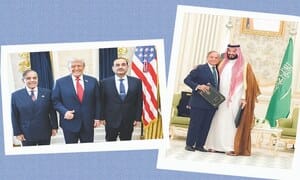
The second, and more consequential, event occurred when Israel’s increasingly belligerent actions culminated in Tel Aviv’s attacks on Doha. This marked a turning point for the Gulf states, particularly Saudi Arabia, and highlighted a harsh reality: advanced air defenses, US guarantees, and discreet channels of normalization would not be enough to protect these countries against an increasingly radical and belligerent Israel. Moreover, the United States, despite being Israel’s protector, would do very little to stop unchecked Israeli actions.
In this context, regional actors began to reconsider who could actually deploy large-scale kinetic capabilities under pressure without collapsing politically or operationally. And this is where Pakistan entered the picture.
However, this opportunity would not have materialized without Pakistan’s military action against India in a brief but intense conflict earlier in the year. Widely considered overstretched and depleted by years of economic and political crises, Pakistan demonstrated that it retained a credible, modern, and integrated conventional combat capability. Its air force, in particular, demonstrated operational competence and command and control sophistication that surprised foreign observers.
The signal did not go unnoticed in the Middle East. Pakistan demonstrated that it could do something no regional army, except Israel, has consistently demonstrated: deploy calibrated, high-end kinetic force without losing control of its airspace. This performance transformed Pakistan from a troubled country into a potential regional security provider. Moreover, the successes in Islamabad demonstrated that, combined with effective training and doctrine, Chinese weapons platforms could outperform next-generation Western systems.
Without this demonstration, the Strategic Defense and Mutual Assistance agreement with Saudi Arabia simply would not have been possible. The pact formalized what had long been implicit, marking a significant shift in the regional power balance.
Suddenly, Pakistan, long viewed through the lens of instability, emerged as a country that could be a net security provider for the region. All this does not mean that Pakistan’s real problems have magically disappeared; 2026 will be a year that will test the country, and to capitalize on this geopolitical moment, Pakistan will have to make significant efforts, many of them at the domestic level.
What’s next? On one hand, the resurgence of the insurgency, fueled by militant sanctuaries across the Afghan border, continues to undermine the state’s capacity and public trust. Without sustained pressure and a coherent strategy toward Kabul, Pakistan risks becoming strategically overextended, even as it seeks a more prominent regional role.